
Car failed WOF? If your car just failed its Warrant of Fitness, your first question is probably how much a WOF costs in NZ and whether the repairs are even worth it. Here’s the honest truth: the inspection fee itself is the cheap part. It’s the repair bill that comes with a failed WOF that decides everything. You might be staring at a sheet listing rust, worn suspension, or a smoky exhaust, with a quote that costs more than the car is worth.
Take a breath. You’re not stuck, and you’ve got more options than you think. This guide walks you through the real costs and helps you decide whether to repair your car or scrap it for cash.
If scrapping turns out to be the smarter option, Otago Car Wrecker can help you sell your failed WOF car quickly with a fair cash offer and free vehicle removal across the region.
The short answer
A standard car WOF in NZ costs about $50 to $90. But if your car fails, the repairs to pass are separate, and that’s where the real money goes. Use the 50% rule to decide: if the repair quote is more than half what your car is worth, scrapping it for cash is usually the smarter move.
How much does a WOF cost in NZ?
There’s no fixed price for a WOF in New Zealand; each provider sets their own fee. For a standard car, you can expect to pay somewhere between $50 and $90 in 2026.
Here’s a rough idea of what the main providers charge:
| Provider | Typical WOF cost (NZD) |
| VTNZ | ~$54 – $85 |
| AA (member discounts apply) | ~$59 |
| Independent garages | ~$45 – $90 |
| Pre-WOF check (optional) | ~$30 – $50 |
A few things worth knowing about the cost:
- The repairs aren’t included. The fee only covers the inspection. If your car fails, you pay separately to fix whatever’s wrong.
- The recheck is free. If you fix the faults and return to the same inspection organisation within 28 days, the re-inspection costs nothing.
- Driving without one is pricey. Driving on an expired or failed WOF can land you a $200 fine, and your insurance may be voided if you crash.
- Bundle it with a service. Many garages throw in a free WOF when you book a full service, saving you $50 or more.
So the inspection is the small bill. The decision that actually costs you money comes next.
What happens when your car fails its WOF?
Around 37–40% of New Zealand vehicles fail their WOF on the first go, so you’re far from alone. When yours fails, here’s what you’re dealing with:
- You get a list of repairs. The inspector hands you a sheet of every item that needs fixing, usually with a rough quote.
- You have 28 days. Fix the faults and return to the same place within 28 days for a free recheck. Miss that window, and you pay for a whole new inspection.
- You can’t really drive it. A failed WOF means your car isn’t road-legal. You can only drive it directly home or directly to a place of repair, nowhere else.
- Your insurance is at risk. If you have an accident while driving on a failed WOF, most insurers can refuse your claim, leaving you to cover the damage.
That 28-day clock is what creates the pressure. You have to make a quick call: fix it, or move on.

The real cost isn’t the WOF, it’s the repairs
This is the part that catches people out. The WOF fee is $50 to $90. The repairs to pass can run into the thousands.
A few blown bulbs or a worn tyre are cheap, easy fixes. But when a WOF fail comes with structural rust, suspension wear, brake faults, or a smoky exhaust, the bills stack up fast — and they tend to come in bundles. One fault is manageable. Four or five at once is when drivers decide they’re done.
For context, here are the big repairs that often turn up at WOF time in NZ:
- Major rust repair — easily four figures, and it keeps spreading
- Suspension and steering work, hundreds to thousands
- Head gasket — averages around $5,900
- Transmission — averages around $9,600
When repairs like those land on a car that’s only worth a few thousand dollars, the maths usually stops making sense.
Car Failed WOF? Repair or scrap? Use the 50% rule
So how do you actually decide? Use the simple test that mechanics and insurers have relied on for years, the 50% rule.
The benchmark question: Is the repair less than half of what the car is worth?
- If yes, repairing it is usually worth it.
- If no, you’re better off selling or scrapping it.
For example, if your car is worth about $6,000 and the WOF repairs are $1,500, that’s only 25% of its value, so fix it. But if the car is worth $3,000 and the repairs come to $2,500, you’re over 80% of its value. Scrapping it and putting that cash toward a better car is the smarter play. For older, high-kilometre cars, drop the threshold to around 40%, since the next bill usually isn’t far behind.
When to repair, and when to scrap
Repairing makes sense when:
- This is the first big bill you’ve had in years.
- The car is otherwise reliable with a clean history.
- The repair is well under half the car’s value.
- A small fix buys you another year while you save for an upgrade.
Scraping makes more sense when:
- The repair quote is around half the car’s value or more.
- It’s old, high-kilometre, and this isn’t its first major bill.
- It failed badly with expensive rust, structural, or safety issues.
- You honestly don’t trust it on the open road anymore.
If you recognise your car in that second list, getting a scrap quote is the logical next step.
Your options after a failed WOF
If the maths says don’t repair, you’ve got a few ways to move on:
Sell it “as is, where is.” You can list it privately and disclose the failed WOF. You might get a bit above scrap value, but expect time-wasters, low-ballers, and buyers using the dead WOF to knock down your price. They’ll also have to arrange a tow, since the car can’t be driven.
Trade it in. Convenient if you’re buying a replacement, but dealers give the lowest value for a broken car, often just a token amount, because they end up taking it to a wrecker anyway.
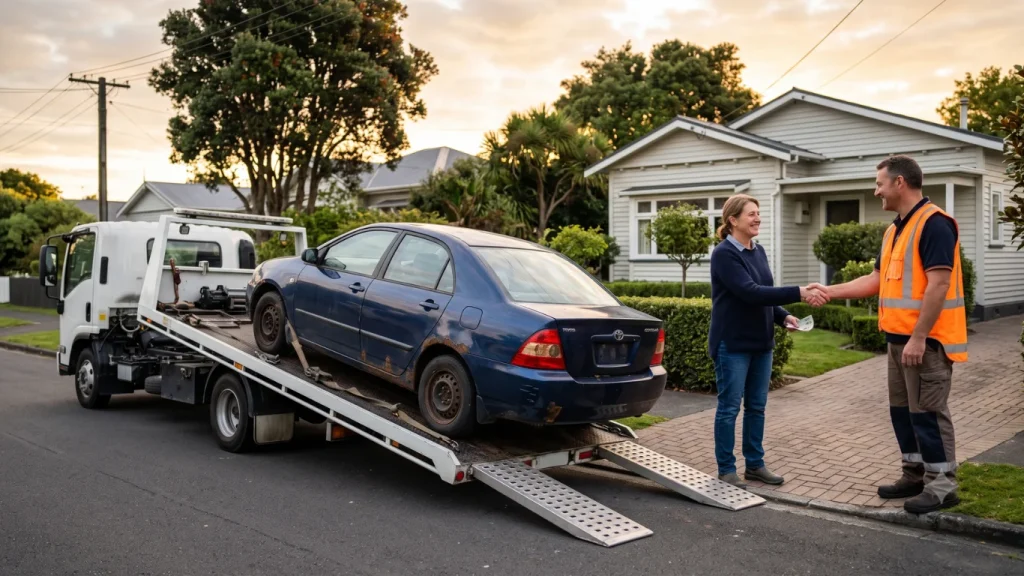
Scrap it for cash. The fastest, least stressful option for a failed WOF car. A licensed Car wrecker pays cash based on the salvageable parts and scrap metal, includes free towing (since the car can’t legally be driven), and sorts the paperwork. You skip the repair bill entirely.
What this looks like in Otago
If you’re in Dunedin, Mosgiel, Oamaru, Balclutha, Alexandra, Cromwell, Queenstown, or anywhere in the wider Otago and Southland region, you don’t have to sink money into a car that’s failed its WOF. A local wrecker can take it off your hands the same day.
At Car Wreckers Otago, we’ve bought cars across the South Island for over 12 years. No WOF, no rego, rusted, damaged, or simply not worth fixing, we’ll give you a fair cash offer, collect it for free, and handle the deregistration paperwork so it’s no longer your problem. If you’re not sure about the rules for damaged or written-off vehicles, the NZ Transport Agency (NZTA) guide on written-off and damaged vehicles provides official information.
Frequently Asked Questions
How much does a WOF cost in NZ?
Is the WOF recheck free if my car failed?
Can I drive my car after it fails its WOF?
How much do WOF repairs usually cost?
Should I repair or scrap a car that failed its WOF?
Can I sell a car that has failed its WOF?
How much is a failed WOF car worth?
How fast can I scrap my car in Otago?
Your Next Step After a Failed WOF
A failed WOF feels like bad news, but it doesn’t have to drain your wallet. The WOF itself only costs $50 to $90; it’s the repairs that make or break the decision. Run the 50% rule. If the repair bill is less than half your car’s value and it’s otherwise reliable, fix it and get back on the road. But if you’re facing a stack of expensive faults on a tired old car, don’t throw good money after bad.
Turn that stress into cash instead. Get a free, no-obligation quote from Car Wreckers Otago today. We pay top cash for cars in any condition and offer free same-day removal anywhere in Otago. Fill out the quick form or give us a call, and your failed WOF car could be gone and paid for by tomorrow.